

Sign in with a code
A six-digit code texted to the number on the record, valid for ten minutes and five attempts; the page answers the same way whether or not the number is known.
Front desk / Patient app
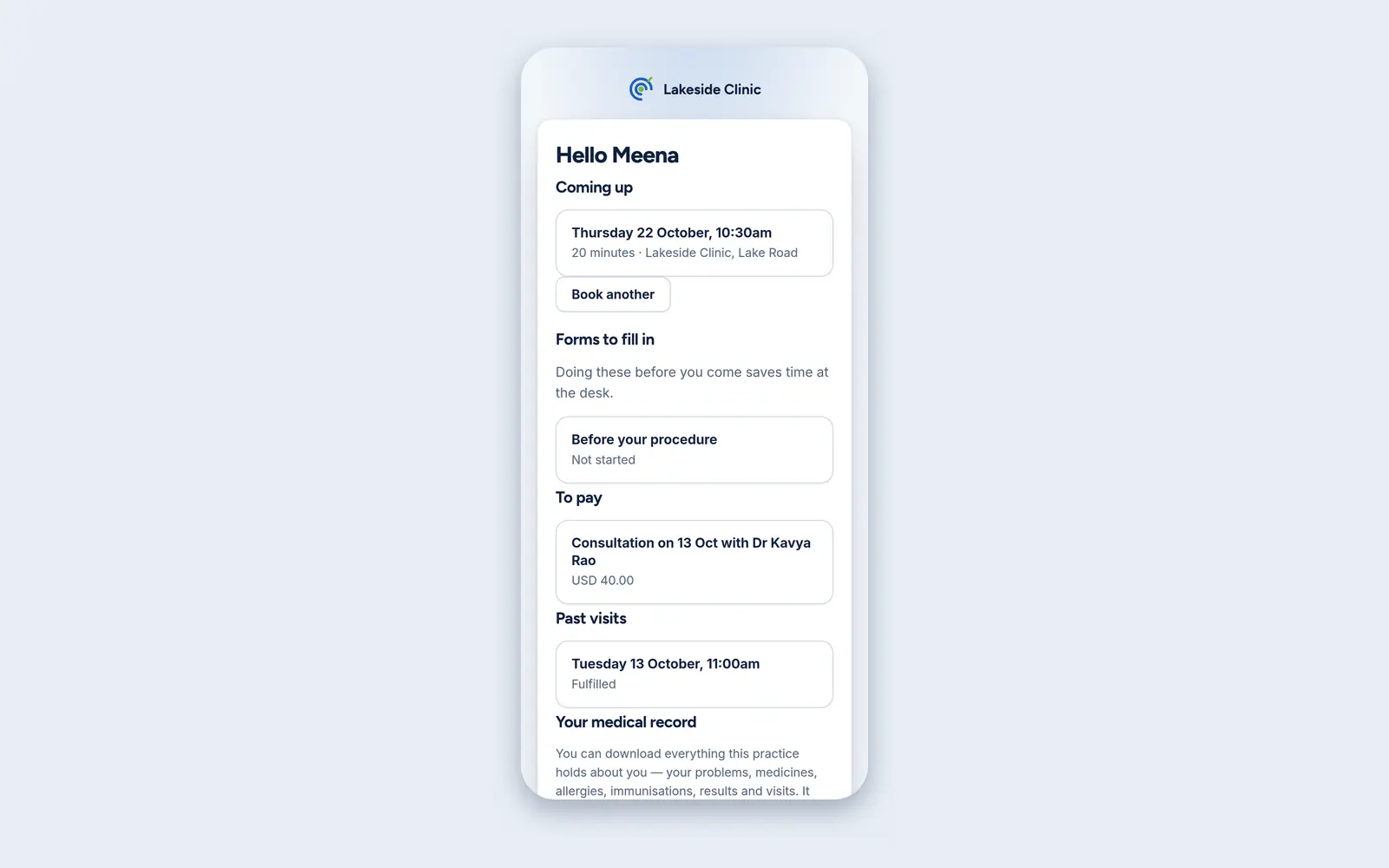
The patient’s own app: what is coming up, what to fill in, what to pay, and their whole record to download. Sign-in uses a code sent to the number on their record, so there is no password to forget.
What it does
A six-digit code texted to the number on the record, valid for ten minutes and five attempts; the page answers the same way whether or not the number is known.
Upcoming appointments, forms to fill in, unpaid bills and past visits — whatever the practice has switched on.
Every page is tied to the signed-in patient. No address carries a record number, so there is nothing to change to see somebody else’s.
A download of the full record as a US Core FHIR file, built from the EMR (with Moving in and out switched on).
Staff can see who is signed in and end all of a patient’s sign-ins at once — for a lost phone — effective on the next tap.
Add to Home Screen in Safari or Install app in Chrome, and it opens like an app. Only the stylesheet and fonts are kept on the phone, never a page.
How it works
With the code sent to the number on the record.
Appointments, forms and bills.
Fill in the form, pay the bill, download the record.
What it needs
Every module switches on and off by itself, per clinic, with its own screens, permissions and audit trail.
Worth knowing
It opens in the phone’s browser. Sessions last twelve hours, and nothing from the record is kept on the phone afterwards.
The demo runs every module against an unmodified OpenEMR, with invented patients. Nothing to install and no sales call.


